
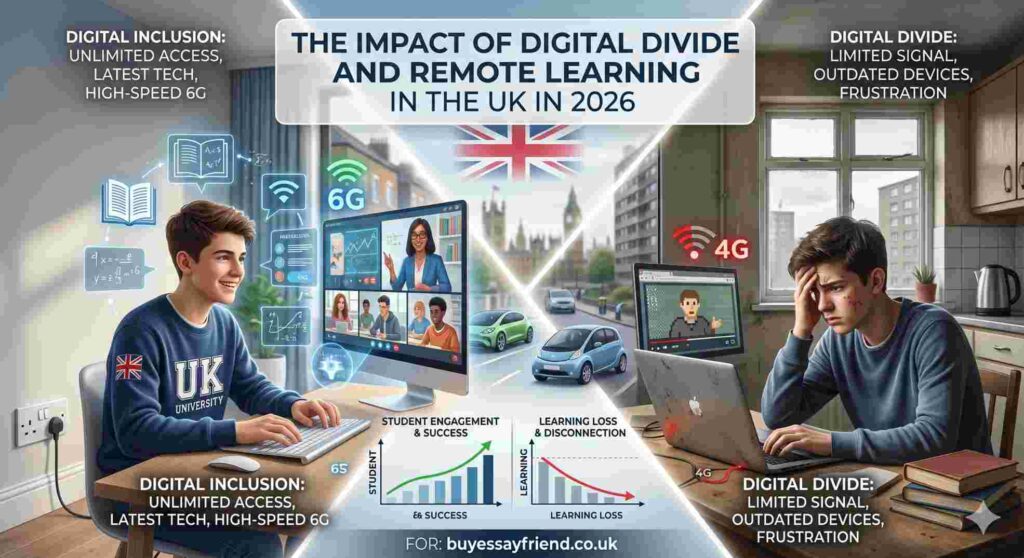
The Impact of Digital Divide and Remote Learning in the UK in 2026
Introduction: New Remote Learning Technology
By 2026, the UK’s education system will have advanced significantly. The old manual method has now been replaced by new digital technology, and it has undergone numerous changes. It has become much better and more modern than before. Now education is not limited to the classroom only, now we can learn even at home. There is no age limit in remote learning, we can complete our education at any age, many schools and universities are now using digital platforms through which students can attend lectures even at home. This modern way of online learning has brought many benefits. Artificial Intelligence is also playing a very important role in remote learning, I will tell you about this in detail in the next topic. The idea of remote learning was first introduced in the form of distance education in Europe (UK) in the 19th century and later in the United Kingdom. It was introduced so that students could acquire knowledge from home through internet and technology. Initially its purpose was distance education but it became very popular across the world in 2020 due to the closure of schools and universities during the COVID-19 period.
Due to the COVID-19 pandemic, this remote learning system spread very fast all over the world. When schools and universities were closed due to lockdown, this remote learning system was implemented in the education department to maintain and run the education system. Initially, it was just a temporary solution so that students’ time could be saved from being wasted, however, with time, it’s very good benefits were seen in the education system and later it was made permanent. Meaning, this is the best option for those students who cannot come to school or university daily.
The Digital Divide also comes into play with Remote Learning. Equality matters a lot in education too. Does every student receive equal quality and equal access to internet and technology during remote learning? Some students have access to fast internet and laptops, while some students do not have both these things. This inequality creates an imbalance in the education system. Because of this difference, the issue of educational equality becomes more clearly visible.
If you need help with Educational Equality and learning assignments, then hire professional UK academic writers from EssaysPro.co.uk and easily get plagiarism-free essays in the UK.
Remote Learning tools Overview
Many digital tools are being used for remote learning in UK schools, colleges and universities. These include learning platforms, video class tools, content and assignment tools, AI and smart learning tools, assessment and tracking tools. There are many software tools working inside these tools, all of which together make a great remote learning system. Now let me tell you one by one about all these tools and the software working in them.
Learning Platforms
Learning Management System (LMS) manages the entire education system. Different software is used to manage this education system.
1- Google Classroom
This is a free LMS from Google. Teachers create classes according to their schedules, share assignments, notes, and announcements with students, and students easily submit their work to the LMS using this software.
2-Microsoft Teams (Education)
This is Microsoft’s virtual classroom platform where live classes are conducted between students and teachers. Students can chat with their teachers during lectures and share files. It is widely used in schools and universities.
3- Moodle
This is an open system LMS that we can customize as we wish. Many UK universities design it to suit their requirements. It has a robust assignment, quiz, and grading system.
4- Blackboard
This software is widely used in universities. Its specialty is advanced grading and analytics features. Its course management structure is very advanced and unique.
Video Class Tools
These tools are widely used in universities for live classes. Among these tools, I will also share with you some famous and mostly used platforms which play an important role in creating real time learning systems.
1- Zoom
This is used for high-quality video meetings. It also has a screen-sharing option, which is very useful. The best part, I think, is that it also has breakout rooms, which means it can divide a large meeting into smaller groups. This feature is a real pro for remote learning.
2- Microsoft Teams Meetings
This is part of the LMS family. It includes recordings of all classes. If you miss a live class by chance, you can easily watch recorded class videos here. Chat history is also saved here.
3- Google Meet
This is a very simple and easy software for attending video classes. It is actually connected to Google Classroom.
Content & Assignment Tools
These tools handle study materials and assignments in remote learning. Here are some of the software used:
1- OneNote Class Notebook
This is a digital notebook system where teachers and students organize their notes.
2- Google Drive (Docs, Sheets, Slides)
This is a cloud storage system where teachers and students share their documents, assignments, presentations, and spreadsheets.
3- Turnitin
This is a very popular plagiarism checking tool. It checks whether an assignment was written by a student themselves or copied. This is a very important tool in universities.
AI & Smart Learning Tools
These are modern AI tools that make learning more modern and smart.
1- Grammarly
It is used to improve writing. Students use it to correct grammar, spelling, or sentences in their assignments.
2- AI-Based Tutoring System
These are virtual tutors that provide students with a complete guide to easily understand any topic. They are used for personalized learning.
3- Chatbots
If students have any questions about any topic, these chatbots provide full support and instant answers. Their support is available 24/7.
Assessment & Tracking Tools
These tools are used to check the performance of the student by checking whether the student is submitting the assignment quizzes on time or not.
1- Online Quizzes
These are in the form of Google Forms or Microsoft Forms. MCQs and short tests are created in this form, and the results are automatically obtained.
2- Learning Analytics System
This software helps track students’ semester-wise progress. It shows their weak and strong areas. Teachers can easily track a student’s performance by viewing this software.
Each tool and software has its own role and together they create a great remote learning system. Remote learning allows students and professionals to access courses from anywhere in the world.
Concept of Digital Divide and its Real Reason
The concept of Digital Divide actually refers to the gap in access to technology present in our society. Its simple meaning is that not every student has equal access to technology. This issue is very common even in a developed country like UK. In urban areas, all students get fast broadband and advanced devices very easily, whereas in rural areas like Scotland, internet connectivity is very weak. This is why some students do not have enough money to buy those advanced devices. Digital divide is not just limited to physical access, rather it also reflects a lack of skills. This means that despite having devices, students do not know how to use them effectively. They have limited understanding of these factions. This gap makes remote learning unequal, meaning not every student has equal opportunities.
Structure and Operation of Remote Learning System
In UK, almost every university has implemented the system of remote learning. This system is very beneficial for the students as well as the teachers. UK universities provide facility of online education not only for physical but also for those students who cannot come to the university, this remote learning system is a God gifted for them. In online classes, teachers give lectures and these lectures are also recorded and recorded lectures are available on LMS. Those students whose picking point is weak can watch these recorded lectures many times and these recorded lectures are very beneficial for those students who cannot attend live lectures for any reason, they can watch these recorded lectures. The biggest advantage of this remote learning is that learning has become flexible. Now every student can study at his own pace and can repeat lectures. This flexibility is achieved only when every student has equal access to this technology.
Impact of Digital Divide on Student Learning Outcomes
The biggest impact of digital divide is on the academic performance of students, meaning if the internet is slow or there are no devices or if the students who do not know how to use the devices effectively will not engage much on LMS or will not be able to submit quizzes and assignments on time, then obviously their academic performance will also be bad. Those students who have high knowledge of using devices and have access to fast internet are more engaged, their understanding is better, they complete the assignments on time and their interaction with teachers is also more, due to which their learning experience also improves and their performance also better. This gap is not limited to marks only, but also affects confidence and motivation. When a student remains stuck despite every effort, his self-belief diminishes. This psychological behavior has a very negative impact on the long-term learning behavior of the students.
Issue of Student Engagement and Participation in Remote Learning
Student engagement is extremely important in remote learning. Students must remain active on the LMS. Submitting assignments on time, taking quizzes, and attending lectures matters a lot. This reflects students’ overall performance. It’s unlike a physical class, where the teacher monitors every student’s activity. In remote learning, staying active is crucial for our own performance. Some students remain active during video lectures, asking questions, and participating in discussions, while others become passive listeners, never asking any questions, which impacts both their performance and confidence. Due to unstable internet, some students fail to participate and miss important discussions, leaving their learning incomplete. Engaging all students simultaneously is also a major challenge for teachers.
Causes of Digital Divide
There is no complex reason for digital divide in UK, first reason is economic inequality i.e. some people are very rich who easily access devices and internet and some people are very poor who remain deprived of these facilities due to lack of money.
The second reason is geographic inequality, meaning that broadband infrastructure is not developed in rural areas, due to which internet speeds are very slow or limited. Urban cities have highly developed broadband infrastructure, hence internet speeds there are very fast and unlimited.
The third reason is digital literacy, meaning a student who has devices and internet also, is not able to use it effectively, just like “A blind squirrel finds a nut once in a while”, meaning it is important to learn to use technology effectively.
The fourth reason is institutional gap. Every school and university does not have equal findings, meaning some institutions provide advanced digital tools while some depend on the basic system.
Case Studies and Practical Examples of Remote Learning in the UK
Many practical examples and case studies of remote learning have been conducted in the UK, with very good results. In March 2023, students at King’s College London’s “Essential Digital Skills Programme” received digital skills training to enable them to use online learning tools effectively. Research has shown that this program boosted student confidence and improved engagement. Another string of practical examples was seen on February 19, 2021, at North Notts College, where students were provided with free laptops and internet hotspot SIMs to facilitate online learning. This also significantly improved student engagement.
Conclusion
Digital Divide is a very serious issue in the UK’s Remote learning system. Technology has made education modern and flexible, but not every student has equal access. This inequality directly affects students’ overall performance and confidence. If the government, schools, and societies work together and stabilize internet speeds even in rural areas and create courses that use technology effectively, the digital divide can be reduced. In the future, the UK’s education system will become more advanced, but its success will depend on how effectively digital inclusion is implemented. Providing equal opportunities to every student is truly educational equality.
Written By: Sidra Gillani