
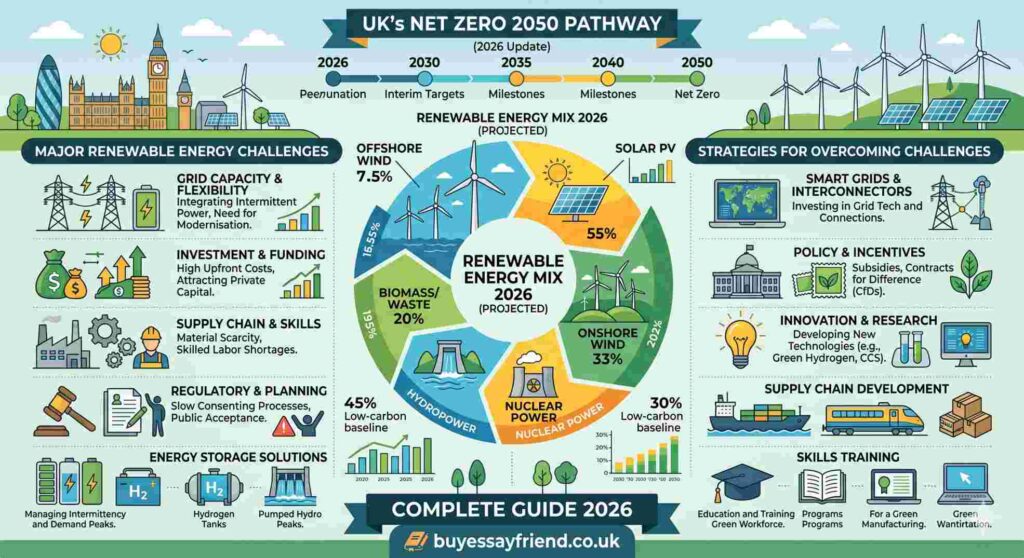
UK’s Net Zero 2050 Goal and Renewable Energy Challenges: The Complete Guide 2026
What is the UK’s Net Zero 2050 target and what are these renewable energy challenges? A detailed review of climate policy and infrastructure issues and greenhouse transitions and future trends in 2026.
Introduction: UK’s Challenging Goals and the Climate Change
By 2026, our entire world has entered the most difficult phase of climate change. The temperature of our earth is gradually increasing. Global warming is no longer a theoretical form, it has become a serious problem in our practical life. The temperature of the entire world is increasing with time, glaciers are melting, sea level is rising with time and due to the weather changing all the time, all the countries are being forced to rethink their police. The UK is also among those developed countries that have transformed their police systems, created better policies, and made climate change a central part of their national strategy.
The UK Government has set a goal of Net Zero Emissions by 2050. This is one of the most ambitious targets in the world. The UK’s goal is to reduce its greenhouse gas emissions so much by 2050 that the amount of emissions released will also be removed from the atmosphere. Meaning, is it the UK’s goal to reduce pollution to almost zero and make such policies by 2050 that climate change will be controlled and a clean energy system will be created. To achieve all these goals, the UK will first change its energy sectors, replace the transportation system, and adapt manufacturing industries, ensuring that households remain unchanged. If fossil fuels are gradually depleted and renewable energy sources are used, the potential for achieving these goals increases significantly. But this journey is not at all simple, hence many structural and technological challenges have to be faced.
If you want help writing an environmental science essay, a UK climate policy essay, or a renewable energy essay, visit our trusted website EssaysPro.co.uk and hire our professional writers now and get a plagiarism-free, professionally structured essay easily.
Concept of Net Zero and its Scientific Importance
This concept of Net Zero has been developed from the research of Climate Science, its main purpose is to stop the global temperature from increasing and to control it. Greenhouse gases like carbon dioxide, methane and nitrous oxide trap this heat in our atmosphere due to which the temperature of our earth increases a lot, we call this phenomenon Greenhouse effect.
Let me explain to you in a simple way that greenhouse effect is actually a process of keeping the earth warm. When solar heat is concentrated on the earth, normally some heat is released back into space, however greenhouse gases trap that heat due to which the earth becomes hotter. If these effects increase, the chances of global warming also increase. Like UK’s Net Zero 2050 goal wants to reduce greenhouse gases so much that the pollution produced is also removed so that overall pollution reaches “zero balance“. The main purpose of this goal is to control global warming and climate change. For this, UK is promoting renewable energy technologies so that the climate can be saved from global warming and the environment can be cleaned. Scientists say that net zero is very important to control climate change and global warming. Scientists of the Intergovernmental Panel on Climate Change have said that if our world does not achieve net zero emissions, the temperature of our Earth could rise to dangerous levels and if global temperature rise is limited to 1.5°C, the whole world could face a lot of problems. And because of these scientific warnings, the UK has adopted the target of net zero 2050 goal.
The purpose of this concept is not only to save the environment, but it is also very beneficial in economic and social development. New industries are being created for renewable energy and greenhouse technologies, which will create millions of job opportunities for people. Apart from this, energy independence will also improve because dependence on fossil fuel imports will reduce.
UK Energy System and Current Situation
The UK’s energy system was previously dependent on fossil fuels such as natural gas, oil, and coal. These have been the major sources of energy production. However, over the past 20 years, the UK has shifted towards renewable energy. Technologies are being invented that reduce pollution. By 2026, many renewable sources are being used in the UK.
1-Wind energy
Wind energy started happening in the UK in 1990 and now it has reached a very big level. Wind energy, particularly offshore wind farms, have become a significant part of the UK’s energy mix. Large-scale wind farms have been developed in the North Sea and Scottish waters, generating clean electricity.
2-Solar Energy
Solar energy gained popularity in the UK in 2010 when solar panels became affordable. Electricity is being generated with the help of the sun, solar panels have been of great help to it. It is also being used a lot now in houses, offices and even in malls.
3-Hydropower
Electricity is being generated from water power. Hydropower are also part of the UK’s clean energy. This technology is very old in the UK, it has been happening since approximately the 19th century, especially in Scotland.
4-Nuclear Energy
Nuclear energy provides electricity continuously, but it also costs more and there are safety concerns. Nuclear energy uses uranium fuel to produce heat and then electricity. This has been happening in the UK since the 1950s.
5-Biomass Energy
The use of biomass energy in the UK peaked in the 2000s. Biomass energy uses wood pellets and organic waste such as fuel.
6-Tidal Energy
Tidal energy is the generation of electricity from oceanic waves and tides. The UK has been conducting experiments and projects in this field since the 1960s and it is still in the developing stage.
All these energies together are providing clean electricity. Their role in the UK net zero 2050 goal is to reduce carbon emissions and replace fossil fuels and make the UK environment clean.
Renewable Energy’s Biggest Challenges:
Renewable energy is clean, but it also has some problems like cost, storage and inconsistent supply. Let me tell you about them.
1-Irregularity and storage
The biggest problem of renewable energy is irregularity. Wind or solar energy is never continuous because sometimes the winds blow very fast and sometimes they stop completely. That is why there is no sunshine all the time. Solar energy is available only during the day and when clouds come, the output becomes very low. To solve this problem, energy saving systems have been developed like lithium-ion batteries, pumped hydro storage and emerging technologies like solid state batteries. These systems are very expensive right now and using them in large-scale deployment faces many problems. Smart grid technology is also a solution to this problem where electricity demand and supply is balanced with the help of real data. Now many modern technologies have come and through Artificial intelligence and machine learning, this system is getting help in becoming more efficient.
2-Elecrticity System & Grid Problems
To use renewable energy systems effectively, we need new power systems and electricity grid. Old grids can never handle wind and solar energy smoothly, hence they need to be upgraded. Integrating renewable energy into the traditional power grid is a very difficult process. The existing grid infrastructure of the UK was based on fossil fuels, hence it is very important to upgrade the system in terms of renewable energy distribution and variables. To upgrade this grid, an investment of million ponds has to be made. In this, transmission lines have to be upgraded, substations have to be modernized and digital monitoring system has to be installed. Another big issue with electricity system and grid problems is planning and approvals for offshore wind farms or nuclear power plants, which take many years to complete, affecting the Net Zero timeline.
3-Economic and Financial Factors
To achieve the Net Zero 2050 target, the UK will need to make huge investments. Renewable energy projects, research and development, infrastructure upgrades, and industrial decarbonisations will all require significant investment to achieve these goals. It is very difficult to collect so much investment in a short time, this can be an economic burden. However, in the long term, this energy will become a source of cost reduction, job creations or innovation. The concept of Green economy is the result of such changes. When we shift from one system to another system, we have to face the problem of prices as well. If fossil fuels are discontinued soon and renewable energy system is not fully ready, there could be a shortage of energy due to which energy prices may increase, which will affect both homes and industries.
4-Changes in the Industrial and Transport Sector
The most difficult part of the Net Zero goal is the decarbonization of the industrial and transport sectors. Some heavy industries, such as steel cement and chemical production, emit high amounts of carbon. To address this problem, technologies that generate hydrogen and capture carbon are being developed. Hydrogen is considered a future fuel that could replace fossil fuels in industry and transportation. You may have noticed that among existing transport technologies, the adoption of electric vehicles has increased significantly. Charging electric systems is also expanding rapidly. Similarly, if we want to achieve large-scale changes, we will have to change consumer behavior and expand the electric system in both industrial and transport sectors.
5-Environmental Impact and Benefits
The biggest benefit of Net Zero or Renewable energy is on the environment. If we control carbon emission then the air quality will automatically improve. Cities will also become clean and health problems which occur due to bad air quality can also be controlled. Asthma and respiratory diseases occur due to bad air quality. If we reduce carbon emission then automatically the air quality will improve. It will help in controlling the extreme effects of climate change such as flooding, droughts, and heatwaves in the long term and will also improve biodiversity. Apart from this, there is an opportunity to restore natural ecosystems such as forests, wetlands, and marine ecosystems.
6-Social Impact and Workforce Transformation
Renewable energy is not just a technological change, it is also a social transformation. Shifting from fossil fuels to renewable energy sectors was a major challenge. Re-skilling programs and trainings are now being launched, teaching workers new skills such as installing solar systems, maintaining wind turbines, and managing energy management systems. The concept of green jobs is rapidly growing in the UK. These jobs are trustworthy and provide long-term economic stability. Public awareness is also playing a very important role in this transition. It is providing full guidance to the citizens on how they can shift to a system-friendly system and adopt energy conversion and sustainable lifestyle.
Case Study: The Success Story of Offshore Wind Energy
The UK’s offshore wind energy project is one of the most successful energy projects in the world. Large-scale wind farms were built in the North Sea and on the Scottish coast, producing gigawatts of electricity. The Hornsea wind farm project is a landmark achievement, providing clean energy to millions of households. This project has proven that large-scale renewable energy is possible. Furthermore, it has also brought significant benefits to the local economy, creating thousands of jobs.
Future of Clean Energy
The UK is using new technologies to achieve its Net Zero 2050 goal. Advanced batteries, smart grids, AI systems, hydrogen technology, and carbon capture systems are improving clean energy. However, these technologies are very expensive and challenging to use for long-term sustainability. Therefore, the UK is introducing green investment and environmental policies to support renewable energy. In the future, the UK’s energy system will be cleaner and more modern, with renewable energy, smart cities, electric transport, and AI-based systems playing an important role.
Conclusion
The UK’s Net Zero 2050 Goal is a very ambitious target that can be achieved with consistent work and hard work. This goal will not only change the environment but will also bring about a complete economic, technological, and social transformation.
Renewable energy is a core pillar of this goal, but infrastructure, investment policies, and new innovations are equally important. This goal will not only bring about positive changes but will also increase job opportunities. If the UK fully targets this goal, it can achieve a sustainable, clean, and green economy by 2050. This journey can become a model not just for the UK but for the whole world.
Written By: Sidra Gillani🦋